Showing posts with label Molecular Simulation. Show all posts

Sunday, May 9, 2021

Osmosis: We can simulate it, but do we really get it?

Computer simulations are useful for developing conceptual understanding of science ideas that are otherwise obscure. However, there are circumstances that simulations just raise more questions than what they answer. Osmosis is one of those deceptively simple phenomena that turn out to be quite challenging to understand, even if it can be simulated with reasonable clarity.
Figure 1. Osmotic pressure.
(Image from Wikipedia)


Osmosis is a process in which solvent molecules move -- without input of energy -- across a semipermeable membrane (which let only the solvent molecules pass) separating two solutions of different concentrations. A typical explanation is that the solvent molecules "want" to equalize the solute concentrations (or equivalently, the solvent concentrations) on the two sides. As a result, the solutions must build up persistent pressure that causes the liquid level in the left side of the U-shape tube shown in Figure 1 to rise remarkably higher against gravity.

Most people just walk away with this theory. But where exactly does the energy that elevates the liquid come from?

In the U-shape tube, no one exerts any force on the liquid in either side, while the force of gravity keeps the liquid level as low as possible. Somehow, by simply making the membrane in the middle partially permeable to only the solvent, some energy is extracted to do the heavy lifting. This process can be simulated using molecular dynamics as is shown in the YouTube video posted above. The simulation shows that, on average, the middle column eventually maintained a noticeably higher level. Removing the solute (the green particles) returned the liquid levels in the three columns to about the same.

In this simulation, the green particles and the blue particles have comparable chemical affinities, meaning that the blue particles do not particularly favor their kins around. Neither do the green particles. The white particles that represent the membrane molecules have very weak interactions with both blue and green particles.

Here is the link to the simulation (which is a Java applet). Happy New Year!

Wednesday, May 7, 2014

Iranian studies show the effectiveness of Molecular Workbench

A Molecular Workbench virtual experiment used in the Iranian study.
In the May Issue of Journal of Educational and Social Research, published by MCSER (Mediterranean Center of Social and Educational Research) in Rome, researchers from Iran and Malaysia reported that "students who were taught using the Molecular Workbench software performed better in post-tests on five chemistry topics as compared with those who received conventional instruction." This study was conducted in Iranian secondary schools with 70 students. The researchers also reported that "students using the software also found this software useful in the learning of chemistry." Their paper, titled with "Molecular Workbench Software as Computer Assisted Instruction to Aid the Learning of Chemistry", is freely available in this open-access journal. The authors are Elaheh Khoshouie, Ahmad Fauzi Mohd Ayub, and Farhad Mesrinejad, from two universities in Iran and Malaysia, respectively.

This example, once again, demonstrates the power of visualization in science education. Regardless of the culture or religion children may have grown up with, scientific visualization transcends all the man-made barriers to convey science messages to the young minds. In the case of Molecular Workbench, the effect is even more profound because the heart of it has actually been written in the universal language of humanity -- mathematics.

Wednesday, October 9, 2013

Molecular modelers won Nobel Prize in Chemistry

Martin Karplus, Michael Levitt, and Arieh Warshel won the 2013 Nobel Prize For Chemistry today "for the development of multiscale models for complex chemical systems."

The Royal Swedish Academy of Sciences said the three scientists' research in the 1970s has helped scientists develop programs that unveil chemical processes. "The work of Karplus, Levitt and Warshel is ground-breaking in that they managed to make Newton's classical physics work side-by-side with the fundamentally different quantum physics," the academy said. "Previously, chemists had to choose to use either/or." Together with a few earlier Nobel Prizes in quantum chemistry, this award consecrates the field of computational chemistry.

Incidentally, Martin Karplus is my postdoc co-adviser Georgios Archontis's thesis adviser at Harvard. Georgios is one of the earlier contributors to CHARMM, a widely-used package of computational chemistry. CHARMM was the computational tool that I used when working with Georgios almost 15 years ago. In collaboration with Martin, Georgios and I were studying glycogen phosphorylase inhibitors based on a free energy perturbation analysis using CHARMM. In another project with Spyros Skourtis, I wrote a multi-scale simulation program that couples molecular dynamics and quantum dynamics to study electron transfer in proteins and DNA molecules (i.e., use Newton's Equation of Motion to predict the trajectories of atoms, construct the Hamiltonian time series, and solve the time-dependent Schrodinger equation using the Hamiltonian series as the input).

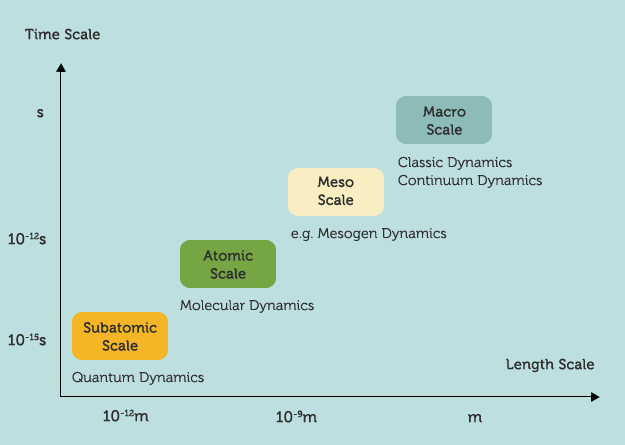
We are thrilled by this news because much of the computational kernels of our Molecular Workbench software was actually inspired by CHARMM. The Molecular Workbench also advocates a multiscale philosophy and pedagogical approach, but for linking concepts at different scales with simulations in order to help students connect the dots and build more unified pictures about science (see the image above).

We are glad to be part of the "Karplus genealogy tree," as Georgios put it when replying my congratulatory email. We hope that through our grassroots work in education, the power of molecular simulation from the top of the scientific research pyramid will enlighten millions of students and ignite their interest and curiosity in science.

Wednesday, August 28, 2013

Modeling the hydrophobic effect of a polymer

There are many concepts in biochemistry that are not as simple as they appear to be. These are things that tend to confuse you if you mull over them. Over the years, I have found osmosis such a thing. Another such thing is hydrophobicity. (As a physicist, I love these puzzles!)

Figure 1: More "polar" solvent on the right.
In our NSF-funded Constructive Chemistry project with Bowling Green State University, Prof. Andrew Torelli and I have identified that the hydrophobic effect may be one of the concepts that would benefit the most from a constructionism approach, which requires students to think more deeply as they must construct a sequence of simulations that explain the origin of this elusive effect. Most students can tell you that hydrophobicity is "water-hating" as their textbooks simply have so written. But this layman's term itself is not accurate and might lend itself to a misconception as if there existed some kind of repulsive force between a solute molecule and the solvent molecules that makes them "hate" each other. An explanation of the hydrophobic effect involves quite a few fundamental concepts such as intermolecular potential and entropy that are cornerstones of chemistry. We would like to see if students can develop a deeper and more coherent understanding while challenged to use these concepts to create an explanatory simulation using our Molecular Workbench software.

Andrew and I spent a couple of weeks doing research and designing simulations to figure out how to make such a complex modeling challenge realistic for his biochemistry students to do. This blog post summarizes our initial findings.

Figure 2. The radii of gyration of the two polymers.
First we decided that we would like to set this challenge on the stage of protein folding. There are few problems in biochemistry that are more fundamental than protein folding. So this would be a good brain teaser that could stimulate student interest. But protein folding is such a complex problem. So we would like to start with a simple 2D polymer that is made of identical monomers. This polymer is just a chain of Lennard-Jones particles linked by elastic bonds. The repulsion core of the Lennard-Jones potential models the excluded volume of each monomer and the elastic bonds link them together as a chain. There is no force that maintains the angles of the chain. So the particles can rotate freely. This model is very rough, but it is already an order of magnitude better than the ideal chain, which assumes a polymer as a random walk and neglects any kind of interactions among monomers.

Figure 3. Identical solvents (weakly polar).
Next we need a solvent model. For simplicity, each solvent molecule is represented by a Lennard-Jones particle. Again, this is a very rough model for water as solvent as it neglects the angular dependence of hydrogen bonds among water molecules. A better 2D model for water is the Mercedes-Benz model, so called because its three-arm model for hydrogen bonding resembles the Mercedes-Benz logo. We will probably include this hydrogen bonding model in our simulation engine in the future, but for now, the angular effect may be secondary for the purpose of this modeling project.

As with themselves, the polymer and solvent molecules interact with each other through a Lennard-Jones potential. Now, the question is: Are these interactions we have in hands sufficient to model the hydrophobic effect? In other words, can the nature of hydrophobicity be explained by using this simple picture of interactions? Would Occam's razor be good in this case? I feel that this is a crucial key to our Constructive Chemistry project: If a knowledge system can be reduced to only a handful of rules students can learn, master, and apply in a short time without being too frustrated, the chance of succeeding in guiding them towards learning through construction-based inquiry and discovery would be much higher. Think about all those successful products out there: LEGO, Minecraft, Algodoo, and so on. Many of them share a striking similarity: They are all based on a set of simple building blocks and rules that even young children can quickly learn and use to construct meaningful objects. Yet, from the simplicity rises extremely complex systems and phenomena. We want to learn from their tremendous successes and invent the overdue equivalents for chemistry and biology. The Constructive Chemistry project should pave the road for that vision.
Figure 4. Identical solvents (strongly polar).

Back to modeling the hydrophobic effect: Does our simple-minded model work? To answer this question, we must be able to investigate the effect of each factor. To do so, we set up two compartments separated by a barrier in the middle. Then we put a 24-bead polymer chain into one of them and then copy it to another. In order for them not to move to the edges or corners of the simulation box (if they stay near the edges then they are not fully solvated), we pin their centers down using an elastic constraint. Next we will put different types of solvent particles into the two compartments. We also use some scripts to keep the temperatures on both sides identical all the time and export the radii of gyration of the two polymers to a graph. The radius of gyration of a polymer approximately describes its dimension.

By keeping everything else but one factor identical in the two compartments, we can investigate exactly what is responsible for the hydrophobic effect for the polymers (or its relative importance). Our hypothesis at this point is that the hydrophobic effect would be more pronounced if the solvent-solvent interaction is stronger. To test this, we set the Lennard-Jones attraction between solvent B (right) particles to be three times stronger than that between solvent A particles, while keeping everything else such as mass and size exactly the same. Figure 1 shows a series of snapshots taken from a nanosecond-long simulation (this model has 550 particles in total, but on my Lenovo X230 tablet it runs speedily). The results show that the polymer on the right folds into a hairpin-like conformation with its two freely-moving terminals pointing outwards from the solvent, suggesting that it attempts to leave the solvent (but cannot because it is pinned down). And this conformation and location last for a long time (in fact most of the time during the simulated nanosecond). In comparison, the polymer on the left has no stable conformation or location -- it is randomly stretched in the solvent most of the time and does not prefer any specific location. I think this is the evidence for the hydrophobic effect in two senses: 1) The polymer attempts to separate from the solvent; and 2) the polymer curls up to make room for more contacts among the solvent particles (this is related to the so-called hydrophobic collapse in the study of protein folding). The second can be further visualized by comparing the radii of gyration (Figure 2), which consistently differ by 2-3 angstroms.

Note that we did not introduce any special interaction between the polymers and the solvent particles of either type. The interaction between the polymer with a solvent particle is exactly the same in both compartments. The only difference is the solvent-solvent interaction. The difference in the simulation results for the two polymers is all because it is energetically more favorable for the solvent particles in the right compartment to stay closer. After numerous collisions (this is sometimes called entropy-driven), the hairpin conformation emerges as the winner for the polymer on the right.
Figure 5: Higher temperatures.

To make sure that there is no mistake, we ran another simulation in which the two solvents were set to be identically weak-polar. Figure 3 shows that there was no clear formation of a stable conformation for either polymer in a nanosecond-long simulation. Neither polymer curled up.

Next we set the two solvents to be identically strong-polar. Figure 4 shows that the two polymers both ended up in a hairpin conformation in a nanosecond-long simulation.

Another test is to raise the temperature but keep the solvent-solvent interaction in the right compartment three times stronger than that in the left compartment. Can the polymer on the right keep its hairpin conformation when heated? Negative, as shown in Figure 5. This actually is related to denaturation, a process in which a protein loses its stable conformation due to heat (or other external stimuli).

These simulations suggest that our simple-minded model might be able to explain the hydrophobic effect and allow students to explore a variety of variables and concepts that are of fundamental importance in biochemistry. Our next steps are to transfer the modeling work we have done to something students can also do. To accomplish this goal, we will have to figure out how to scaffold the modeling steps to provide some guidance.

Sunday, June 30, 2013

First research paper using the Molecular Workbench submitted to arXiv

Credit: M. Rendi, A.S. Suprijadi, & S. Viridi
Researchers from Institut Teknologi Bandung, Indonesia recently submitted a paper "Modeling Of Blood Vessel Constriction In 2-D Case Using Molecular Dynamics Method" to arXiv (an open e-print repository), in which they claimed: "Blood vessel constriction is simulated with particle-based method using a molecular dynamics authoring software known as Molecular Workbench. Blood flow and vessel wall, the only components considered in constructing a blood vessel, are all represented in particle form with interaction potentials: Lennard-Jones potential, push-pull spring potential, and bending spring potential. Influence of medium or blood plasma is accommodated in plasma viscosity through Stokes drag force. It has been observed that pressure p is increased as constriction c is increased. Leakage of blood vessel starts at 80 % constriction, which shows existence of maximum pressure that can be overcome by vessel wall."

This blog article is not to endorse their paper but to use this example to illustrate the point that a piece of simulation software that was originally intended to be an educational tool can turn out to be also useful to scientists. If you are a teacher, don't you want your students to have such a tool that assumes no boundary to what they can do? The science education community has published numerous papers about how to teach students think and act like a scientist, but much less has been done to actually empower them with tools they can realistically use.

Tuesday, February 12, 2013

A mixed-reality gas lab

In his Critique of Pure Reason, the Enlightenment philosopher Immanuel Kant asserted that “conception without perception is empty, perception without conception is blind. The understanding can intuit nothing, the senses can think nothing. Only through their unison can knowledge arise.” More than 200 years later, his wisdom is still enlightening our NSF-funded Mixed-Reality Labs project.

Mixed reality (more commonly known as augmented reality) refers to the blending of real and virtual worlds to create new environments where physical and digital objects co-exist and interact in real time to provide user experiences that are impossible in only real or virtual world. Mixed reality provides a perfect technology to promote the unison of perception and conception. Perception happens in the real world, whereas conception can be enhanced by the virtual world. Knitting the real and virtual worlds together, we can build a pathway that leads perceptual experiences to conceptual development.

We have developed and perfected a prototype of mixed reality for teaching the Kinetic Molecular Theory and the gas laws using our Frame technology. This Gas Frame uses three different types of sensors to translate user inputs into changes of variables in a molecular simulation on the computer: A temperature sensor is used to detect thermal changes in the real world and then change the temperature of the gas molecules in the virtual world; a gas pressure sensor is used to detect gas compression or decompression in the real world and then change the density of the gas molecules in the virtual world; a force sensor is used to detect force changes in the real world and then change the force on a piston in the virtual world. Because of this underlying linkage with the real world through the sensors, the simulation appears to be "smart" enough to detect user actions and react in meaningful ways accordingly.

Each sensor is attached to a physical object installed along the edge of the computer screen (see the illustration above). The temperature sensor is attached to a thermal contact area made of highly conductive material, the gas pressure sensor is attached to a syringe, and the force sensor is attached to a spring that provides some kind of force feedback. These three physical objects provide the real-world contextualization of the interactions. In this way, the Gas Frame not only produces an illusion as if students could directly manipulate tiny gas molecules, but also creates a natural association between microscopic concepts and macroscopic perception. Uniting the actions of students in the real world and the reactions of the molecules in the virtual world, the Gas Frame provides an unprecedented way of learning a set of important concepts in physical science.

Pilot tests of the Gas Frame will begin at Concord-Carlisle High School this week and, collaborating with our project partners Drs. Jennie Chiu and Jie Chao at the University of Virginia, unfold at several middle schools in Virginia shortly. Through the planned sequence of studies, we hope to understand the cognitive aspects of mixed reality, especially on whether perceptual changes can lead to conceptual changes in this particular kind of setup.

Acknowledgements: My colleague Ed Hazzard made a beautiful wood prototype of the Frame (in which we can hide the messy wires and sensor parts). The current version of the Gas Frame uses Vernier's sensors and a Java API to their sensors developed primarily by Scott Cytacki. This work is made possible by the National Science Foundation.

Thursday, January 17, 2013

Constructive chemistry funded by the National Science Foundation

One of the most effective pedagogies in science education is to challenge students to design and construct something that performs a function, solves a problem, or proves a hypothesis. Learning by design is a very compelling way of engaging students to learn science profoundly. Given the extensive incorporation and emphasis of engineering design across disciplines in the Next Generation Science Standards, design-based learning will only grow more important in US science education.

The problem, however, is that many science concepts are related to things that are too small, too big, too complex, too expensive, or too dangerous to be built in the classroom realistically. (If you are a LEGO fan, you may argue that LEGO can be used to build anything, but most LEGO models simulate the appearance but not the function -- a LEGO bike probably cannot roll and LEGO molecules probably do not assemble themselves. To scientists and engineers, functions are all that matters.)

Three approaches of using science models.
A good solution is to have students design computer models that work in cyberspace. This virtualization allows students to take on any design challenge without regard to the expense, hazard, and scale of the challenge. If the computer modeling environment is supported by computational science derived from fundamental laws, it will have the predictive power that permits anyone to design and test any model that falls within the range governed by the laws. Software systems that provide user interfaces for designing, constructing, testing, and evaluating solutions iteratively can potentially become powerful learning systems as they create an abundance of opportunities to motivate students to learn and apply the pertinent science concepts actively. This is the vision of "Constructive Science" that I had dreamed about almost four years ago. This constructive approach opens up a much larger learning space that can result in deeper and broader learning--beyond simply observing and interacting with existing science simulations that were created to assist teaching and learning.

This dream got a shot in the arm today by a small grant awarded by the National Science Foundation. This TUES Type-1 grant will support a collaboration with Bowling Green State University and Dakota County Technical College to pilot test the idea of "Constructive Chemistry" at the college level. Choosing chemistry as a test bed to explore this Constructive Science approach is most appropriate, as chemistry is all about atoms and molecules that are just too small to make any design-based learning option other than computational modeling viable. Decades of research in computational chemistry has developed the computational power needed to make the science right. We believe that using these computational methods should yield chemistry simulations that are sufficiently authentic for teaching and learning.

Saturday, October 20, 2012

Think Molecularly: Incredibly Simple Infrared Imaging Experiments Open a Door to Incredibly Deep Scientific Explorations

Figure 1
One of the most fascinating parts of science is the search for answers to strange phenomena. In the past nine months, I have posted more than fifty IR videos on my Infrared YouTube channel. These experiments are all very easy to do, but not all of them are easy to explain and some of them appear to be quite strange at first glance. In this article, I will try to explain one of those experiments, with one of my other skills -- molecular simulation.

Warming surprise

This incredibly simple IR experiment is about putting a piece of paper above a cup of room temperature (nearly) water (Figure 1). I hear you saying, what is the big deal of it? You have probably done that several times in your life, for whatever reasons.

If you happen to have an IR camera and you watch this process through it, you may be surprised. Many of you know that water in an open cup is slightly cooler ( 1-2°C lower) than room temperature because of evaporative cooling: constant evaporation of water molecules from liquid water takes thermal energy away from the cup and causes it to be a bit cooler than the room temperature (which is why you feel cold when you just step out of a swimming pool). You may think that the paper would also cool down when you put it on top of the water because at room temperature paper is a bit warmer than the water in the cup and, based on what your science teacher in high school has told you, heat would flow from the warmer paper to the cooler water, causing the temperature of the paper to drop a bit.

Figure 2 (Watch it in YouTube)
But the result was exactly the opposite -- the paper actually warmed up (Figure 2)! And the warming appeared to be pretty significant -- up to 2°C could be observed in a dry winter day. I don't know your reaction to this finding, but I was baffled when I saw it because this effect first appeared to be a violation of the Second Law of Thermodynamics (which, of course, is impossible)! In fact, the reason I did this experiment at that time was to figure out how sensitive my IR camera might be. My intention was to exploit the evaporative cooling of water to provide a small, stable thermal gradient. I was examining if the IR camera could capture the weak heat transfer between the water and the paper.

Figure 3 (Watch it in YouTube)
I quickly figured out that the culprit responsible for this surprising warming phenomenon must come from the water vapor, which we cannot see with the naked eye. But what we can't see doesn't mean it doesn't exist. When water molecules in the vapor encounters the surface molecules of the paper, they will be captured (this is known as adsorption). When more and more water molecules are captured and condense onto the paper surface, they will return to the liquid state and, according to the Law of Conservation of Energy, release the excessive energy they carry, which causes the paper to warm up. In other words, the paper somehow recovers the energy that the water in the cup lost through evaporation. As you can see now, this is a pretty delicate thermodynamic cycle that connects two phase changes, evaporation and condensation, in two different places and their latent heats. The physicists among us would appreciate if I say that this shows entropy at work: evaporation is an entropic effect caused by water molecules wanting to maximize their entropy by leaving their more organized liquid state. The interaction between the vapor molecules and the paper molecules acts to reverse this process by returning the water molecules to the condensed liquid state and a certain amount of net energy can be extracted from this (known as the enthalpy of vaporization). Of course, the adsorption process itself, caused by the hydrogen bonding between water molecules and paper molecules, releases some amount of heat that contributes to the warming effect as well.

Figure 4: Sensor results.
At this point, I hope you have been enticed enough to want to try this out yourself. If you don't have an IR camera, you can use a temperature sensor or an IR thermometer as a substitution to observe this phenomenon (undoubtedly, nothing beats an IR camera in terms of seeing heat -- with a point thermometer you just need to be patient and be willing to do more tedious work).

But wait, this is not the end of the story!

Dynamic equilibrium

If you keep observing the paper, you will see that this condensation warming effect will diminish in a few minutes (Figure 3). This trend is more clearly shown in Figure 4 in which the temperature of the paper was recorded for ten minutes using a fast-response surface temperature sensor. What the heck happened?

Figure 5 (Watch it in YouTube)
The answer to this question can be illustrated using a schematic molecular simulation (Figure 5) I designed to explain the underlying molecular physics (in that simulation water molecules are simplified as single round particles). After water molecules condense onto the paper surface, a thin layer of condensate will form. When it becomes thick enough, water molecules will evaporate from it, too, just like from the surface layer of water in the cup. When the rate of evaporation equals the rate of condensation, there is no more net warming: The condensation warming and evaporative cooling will eventually reach a "break-even" point. Reaching this equilibrium state doesn't mean that condensation and evaporation on the surface of the paper will stop. In fact, water molecules will keep condensing to the layer and evaporating from it. This is known as "dynamic equilibrium." If you move the paper, you will break this dynamic equilibrium. Figure 6 shows a pattern in which evaporative cooling and condensation warming occurred simultaneously on a single piece of paper after the paper had been shifted a bit. In Figure 6, evaporation dominated in the blue zone that was shifted out of the cup area, condensation dominated in the white zone that was shifted into the cup area, and the overlap zone in the middle remained close to the equilibrium state because it was the zone that still remained inside the cup area -- so business as usual.

Figure 6 (Watch it in YouTube)
As you can see, there is a lot of science in this "simple" experiment! But nothing we have done so far requires expensive materials or supplies. Everything needed to do this experiment is probably within the reach of your arms if you are reading this article at home (and you happen to have a digital thermometer, or better, an IR camera, nearby). If you are an educator, this experiment should fascinate you because this will be a perfect inquiry activity for students. If you are a scientist, this experiment should fascinate you because what I have shown you is in fact an atomic layer deposition experiment that anyone can do -- some Fermi calculation suggests that the thickness of the layer is in the nanometer range (only a few hundred layers of water molecules or 1/10,000th of the diameter of your hair). What we are seeing is in fact a signal from the nanoscale world! Isn't that cool?

Figure 7 (Watch it in YouTube)
Does our story end now? Absolutely not. The new questions you can ask are practically endless if you keep "thinking molecularly." The following are six extended questions I have asked myself. You can try to explore all of these without leaving your kitchen.

When will the paper cool down?

Returning to the original purpose of my experiment (looking for cooling due to heat transfer), can we find a situation in which we will indeed see cooling instead of warming? Yes, if the water is cold enough (Figure 7). When the water is cold, the evaporation rate drops. There will be less water molecules hitting the surface of the paper. The energy gain from weaker condensation warming cannot compensate the energy loss due to the heat transfer between the paper and the cold water. (By the way, I think the heat transfer in this case is predominantly radiative, because air doesn't conduct heat well and natural convection acts against heat transfer in this situation.)

What if the paper has been atop the water for a long time?
Figure 8 (Watch it in YouTube)

If you leave the paper atop the cup of water (water slightly cooler than room temperature, not ice water) for a few hours and you come back to examine it, you would probably be surprised again: The paper is now cooler than room temperature (Figure 8). I wouldn't be surprised if you are totally confused now: This warming and cooling business is indeed quite complicated -- even though everything we have done so far has been limited to manipulating paper and water. To keep the story short, I will tell you that this is because water molecules have traveled through the porous layer of the paper through capillary action and shown up on the other side of the paper (this molecular movement is often known as percolation). Their evaporation from the upper side of the paper cools down the paper. The building science guys among us can use this experiment to teach moisture transport through materials. Can the temperature of the upper side be somehow used to gauge the moisture vapor transmission rate (MVTR) of a porous material? If so, this may provide a way to automatically measure MVTR of different materials. The American Society for Testing and Materials already has established a standard based on IR sensors. Perhaps this experiment can be related to that.

Different materials have different dew points?

Figure 9 (Watch it in YouTube)
Do water molecules condense to other materials such as plastic? We know plastic materials do not absorb water (which is why they are good vapor barriers). If plastic materials are not cold enough, water molecules do not condense to them. Figure 9 shows this difference by using a piece of paper half-covered by a transparency film taped to the underside. Warming was only observed in the paper part, indicating water molecules do not condense to the plastic film. This experiment raises an interesting question: The so-called dew point, the temperature below which the water vapor in the air at a constant barometric pressure will condense into liquid water, may not be an entirely reliable way to predict condensation. Condensation actually depends on the chemical property of the material surface. Hydrophobic (water-hating) materials like plastic tend to have a low dew point, whereas hydrophilic (water-loving) materials tend to have a high dew point. The porosity of the material should matter, too, because a more porous material will provide a large surface for interaction with water molecule -- paper happens to be such a material because of its fiber texture.

Figure 10 (Watch it in YouTube)
Vapor pressure depression

What will happen if we add some salt (or baking soda or sugar) to the water? Figure 10 shows that the condensation warming effect becomes weaker. For our chemist friends, this is known as vapor pressure depression. The salt ions do not evaporate themselves, but their presence in a solution somehow slows down the evaporation of water molecules.

A vapor column?

What will happen if the paper approaches the water from a different angle such as in the vertical direction? How does the shape of the water vapor distribution above a cup of water look like? Does it look like a steam from a cup of coffee? Figure 11 could probably give you some clue.

What about alcohol?

Figure 11 (Watch it in YouTube)
So far we have used only water. What about other liquids? Alcohol is pretty volatile. So I tried some isopropyl alcohol (91%). Once again, I was baffled. Our experience with applying rubbing alcohol to our skin says that alcohol cools faster than water. So I expected that when the isopropanol  molecules condense, they would release more heat. But this is not what Figure 12 suggests! Given the fact that the enthalpies of vaporization of alcohol and water are 44 and 41 kJ/mol, respectively, the only sensible explanation may be that the warming effect is not only due to the condensation of the vapor molecules, but also the interaction between the vapor molecules and the cellulose molecules of the paper. If the interaction between an alcohol molecule and a cellulose molecule is weaker, then the adsorption rate will be slower and the adsorption of the alcohol molecule onto the paper surface will produce less heat. I don't know how to prove this now, but this could be a good topic of research.
Figure 12 (Watch it in YouTube)

Concluding remark

Even if this is a lengthy article (and thanks for making it to the end), I am pretty sure that the scientific exploration does not stop here. There are other questions that you can ask yourself. For me, I have been intrigued by the fascinating thermodynamic cycles in a humble cup of water and have been wondering if they could be used to engineer something that can harvest the latent heats of evaporation and condensation. In other words, could we turn a cup of water into a tiny power plant to, say, charge my cell phone? In theory, this is possible as any temperature gradient, however weak it may be, can be translated into electric current using a thermoelectric generator based on the Seebeck effect. The evaporation of water molecules from an open cup is a free gift of entropy from Mother Nature that ought to be harnessed some day.